Experiment
Now, let’s visualize what we’ve learned using an experiment.
We will also use this experiment to answer our previously asked question: Why do professional cyclists bend down so much, or, how does different positions on cycling help decreasing air resistance?
From the previous explanation, it is easy to make the hypothesis that: Professional cyclists choose to bend down to decrease the air resistance, therefore increasing their speed.
IV: Different positions: e.g. if the cyclist is bending down/is the cyclist is sitting straight
DV: Distance of the bike.
CV: Because the Area of human is measured in the formula, other factors in the formula must stay the same. This means:
- Frontal Area of bike (which means the bike doesn’t change)
- Velocity of the bike, which means the bike enters at the same speed for every try.
- Density of air, which means the experiment has to be conducted during the same day, same area so the density of air doesn’t change.
- Drag coefficient, which means the bike should be kept the same for this experiment.
Materials: Bike*1, camera*1, measuring tape*1, angle meter *1, stopwatch*1
Procedure:
Procedure:
- Find an empty, outdoor road that is flat and suitable for cycling, and it should be long enough.
- Mark a point, when the bike passes this point it shouldn’t further accelerate.
- Start the experiment, ride a bike from one end of the road and accelerate. Make sure the body is 90 degrees from the ground, straight.
- The bike should stop accelerating once it reaches 15km/h, and pedal to sustain this speed.
- Once the bike passes the point previously marked, stop pedaling and let the bike gradually decelerate itself (not with brakes)
- The bike will eventually come to an end. Use the measuring tape to measure the distance it took for the bike to stop.
- Repeat steps 3-6 for 3 times to ensure accuracy.
- Now, repeat steps 3-7 for 2 more times, but each time, change the body tilted degree from 90 degrees to 45 degrees and 0 degrees, respectively.
- Note down the data
Footage of the experiment:
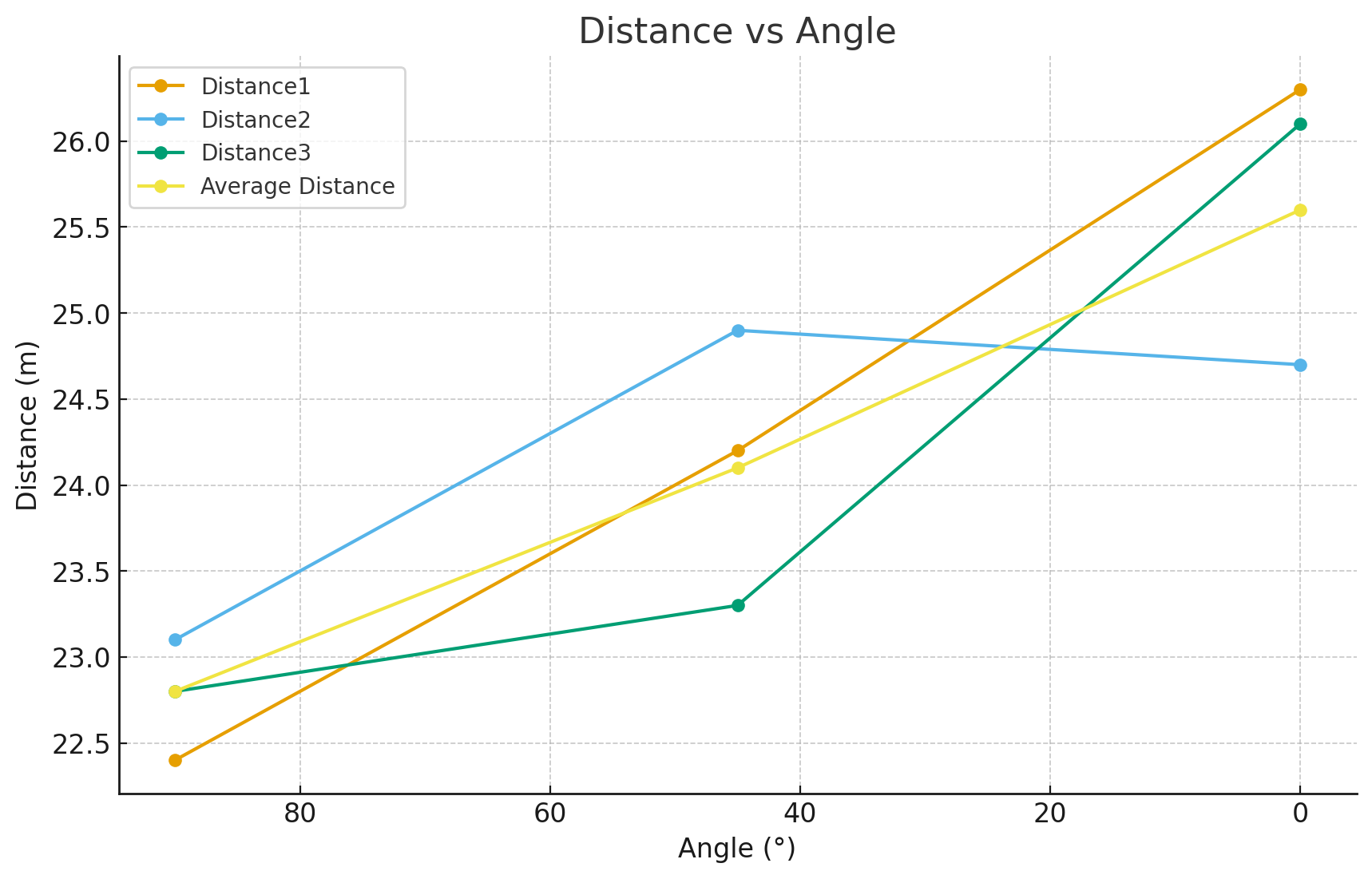
Data:
| Angle(°) | Distance1(m) | Distance2(m) | Distance3(m) | Average Distance(m) |
|---|---|---|---|---|
| 90 | 22.4 | 23.1 | 22.8 | 22.8 |
| 45 | 24.2 | 24.9 | 23.3 | 24.1 |
| 0 | 26.3 | 24.7 | 26.1 | 25.6 |
Conclusion:
Conclusion:
From the data above, the conclusion could be made that the bike is able to go further using the same amount of force when the degree the body bends is lower. From this result, it could be analyzed that the less the angle tilted, the less air resistance. This is because the ability to go further distance using the same amount of force means that there is less resistive force acting the opposite direction to the object.
Explanation of why this is true is made in the previous page (Air resistance page), where it is explained that the air resistance is related to the frontal area of the moving object.
Therefore, the conclusion could be made that professional cyclists choose to bend down so much so that they can decrease the air resistance they face, therefore maximizing the use of their energy, allowing them to cycle faster.
Evaluation:
Evaluation:
Overall, the experiment was quite successful because it demonstrates the relationship between body angle positions and air resistance successfully. The data is also explainable using the air resistance formula explained previously.
One improvement that could be made is to apply an electrical motor on the bicycle that provides power, so that the force pushing the bike is always the same, ensurign the accuracy of the experiment. This is because in the current experiment, the force applied to the bike is done through pedaling, which isn't 100% accurate in terms of providng the same amount of force each time, even though I tried my best to keep it the same, and there are tools on the phone that measures the speed to ensure the bike reaches the same speed before it stops pedaling.
Another improvement that could be made is that there could be someone that does the experiment with me, so that the other person could ensure the experiment is correctly conducted. This is because a problem I noticed in this experiment is that my body isn't eactly at 90 degrees or 0 degrees when I'm conducting the experiment, although it is quite close. Having another person to assist me by ensuring my body angle is correct would greatly improve the accuracy of the experiment.